Groundwater Management Strategies for Ensuring Tunnel Safety at the Hospital Kuala Lumpur Station
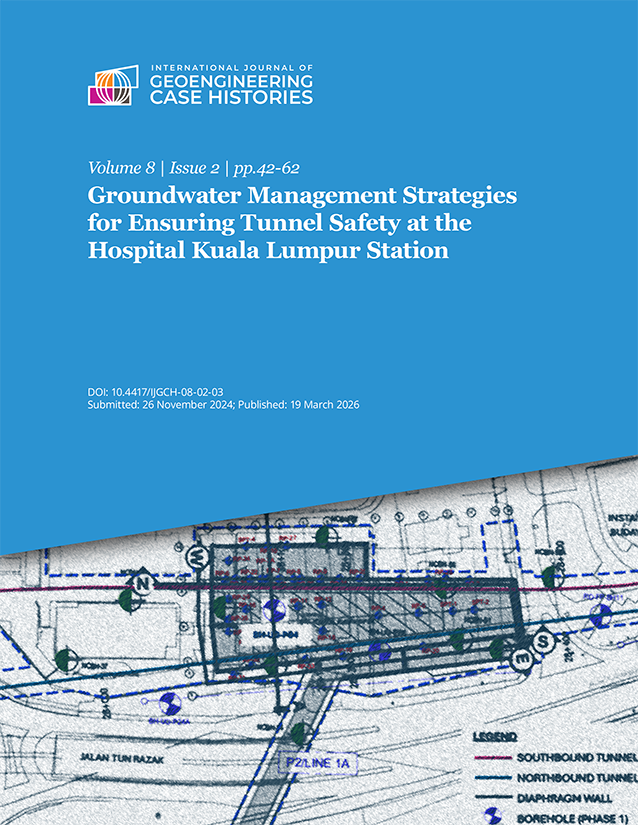
Volume 8 – Issue 2
Authors: Chee Min Khoo ; Chia Weng Boon
Keywords
Groundwater Management, Hydrogeology, Tunnel Safety, Tunnel Flotation, Deep Excavation, Weathered Quartz
Abstract
This paper presents a detailed case history of groundwater management implemented to ensure the safety of temporary twin TBM bored tunnels within the excavation and construction of an underground metro station in an urban environment. The metro station, constructed using the top-down construction method with tunnels bored prior to the deep excavation, is located within the Kenny Hill Formation in Kuala Lumpur, Malaysia, interfacing with the weathered quartz intrusions. The weathered material of the quartz intrusions consists of significant amounts of medium and fine sand, which are considered to be erodible. The presence of groundwater and highly permeable materials posed risks of tunnel flotation and challenges to preserving the stability and safety of the deep excavation. This study focuses on the methods and techniques employed to temporarily manage groundwater levels within the excavation to minimize the subsequent impact on the tunnel integrity. Through comprehensive monitoring and data analysis, the effectiveness of the groundwater management strategy is evaluated. The findings demonstrate that well-planned and executed groundwater management can significantly enhance tunnel safety, minimizing the risks associated with tunnel flotation and instability. This case history provides valuable insights into effective groundwater management practices in similar geological and urban settings.